Solutions
Hardware
Software
Services
Support and Downloads
About Zebra
ET401 Enterprise Tablet Product Reference Guide
Accessories
Expansion Back
Removing the Expansion Back
ET401 Product Reference Guide
ET401 Product Reference Guide
About this Guide
Configurations
Notational Conventions
Icon Conventions
Service Information
Determining Software Versions
Determining the Serial Number
Getting Started
Unpacking the Device
Device Features
Setting Up the Device
Installing a SIM Card
Installing the microSD Card
Activating an eSIM
Deactivating an eSIM
Erasing an eSIM Profile
Turning off the Display
Turning off the Device
Using the Device
Home Screen
Setting the Home Screen Rotation
Status Bar
Notification Icons
Status Icons
Managing Notifications
Opening the Quick Access Panel
Quick Access Panel Icons
Editing the Quick Access Tiles
Interactive Sensor Technology
Waking the Device
USB Communication
Transferring Files
Transferring Photos
Disconnecting from the Host Computer
Power over Ethernet (PoE)
Setting up PoE
Settings
Accessing Settings
Display Settings
Setting the Screen Brightness Automatically
Setting the Screen Brightness Manually
Setting Night Light
Setting Screen Rotation
Setting Display Timeout
Setting Lock Screen Notifications
Setting Font and Display Size
Setting Touch Panel Mode
Setting the Date and Time
General Sound Setting
Sound Options
Zebra Volume Controls
Keyboards
Enabling Keyboards
Switching Between Keyboards
Using the Keyboards
Edit Text
Entering Numbers, Symbols, and Special Characters
Enterprise Keyboard
Numeric Tab
Alpha Tab
Additional Character Tab
Scan Tab
Language Usage
Changing the Language Setting
Adding Words to the Dictionary
Notifications
Enabling Blink Light
Applications
Installed Applications
Accessing Apps
Switching Between Recent Apps
Battery Manager
Opening Battery Manager
Battery Manager Information
Camera
Taking Photos
Recording Videos
Camera Settings
Camera Preview Size Limitation
DWDemo
DWDemo Icons
Selecting a Scanner
Data Capture
Imaging
Scanning Considerations
Scanning with an Internal Scanner
Integrated RFID
Scanning with Integrated RFID
RFID Scanning Considerations
Scanning with the Camera
Scanning with the RS507/RS507X Hands-Free Imager
Scanning with the RS5100 Ring Scanner
Scanning with the RS6000 Bluetooth Ring Scanner
Scanning with the RS6100 Bluetooth Ring Scanner
Scanning with the DS2278 Digital Scanner
Scanning with the DS3678 Bluetooth Scanner
Scanning with the DS8178 Digital Scanner
Scanning with the LI3678 Linear Imager
DataWedge
Enabling DataWedge
Disabling DataWedge
Pairing a Bluetooth Ring Scanner
Pairing in SSI Mode Using Near Field Communication
Pairing in HID Mode Using Near Field Communication
Pairing Using Simple Serial Interface (SSI)
Pairing the Ring Scanner Using Bluetooth Human Interface Device
Pairing a Bluetooth Scanner
Pairing Using Simple Serial Interface
Pairing Using Bluetooth Human Interface Device
Supported Decoders
SE4100 Internal Imager Supported Decoders
SR500 Internal Imager Supported Decoders
Camera Supported Decoders
RS507/RS507x Supported Decoders
RS5100 Supported Decoders
RS6000 Supported Decoders
RS6100 Supported Decoders
DS2278 Supported Decoders
DS3678 Supported Decoders
DS8178 Supported Decoders
LI3678 Supported Decoders
Wireless
Wireless Wide Area Networks
Sharing the Mobile Data Connection
Enabling USB Tethering
Enabling Bluetooth Tethering
Enabling Wi-Fi Hotspot
Configuring the Wi-Fi Hotspot
Data Usage
Setting Data Usage Warning
Setting Data Limit
Cellular Network Settings
Data When Roaming
Enabling MMS Messages
Setting Preferred Network Type
Setting Preferred Network
Configuring the Access Point Name
Locking the SIM Card
Supported Frequency Bands
Wireless Local Area Networks
Connecting to a Wi-Fi Network
Removing a Wi-Fi Network
WLAN Configuration
Configuring a Secure Wi-Fi Network
Manually Adding a Wi-Fi Network
Configuring for a Proxy Server
Configuring the Device to Use a Static IP Address
Wi-Fi Preferences
Additional Wi-Fi Settings
Enabling Wi-Fi Direct
Bluetooth
Adaptive Frequency Hopping
Security
Bluetooth Profiles
Bluetooth Power States
Enabling Bluetooth
Disabling Bluetooth
Discovering Bluetooth Device(s)
Changing the Bluetooth Name
Connecting to a Bluetooth Device
Selecting Profiles on the Bluetooth Device
Unpairing a Bluetooth Device
Cast
Near Field Communications
Reading NFC Cards
Enterprise NFC Settings
Accessories
Charging the Device
Charging Indicators
Charging Temperature
1-Slot Power Delivery (PD) Charging Cradle
Setup
4-Slot Charge-Only Cradle
Setup
Installing the Insert
Connect Hub
Inserting the Device into the Connect Hub Cradle
PowerPack
Installing the PowerPack
PowerPack Charging Indicators
4-Slot PowerPack Battery Charger
Setup
Installing the 4-Slot PowerPack Battery Charger
Rugged Boot
Installing the Rugged Boot
Adapter Boot
Installing the Adapter Boot
D-Clips
Attaching the Shoulder Strap
Expansion Back
Installing the Expansion Back
Removing the Expansion Back
Replacing the Hand Strap
VESA Mount
Installing the VESA Mount
Application Deployment
Android Security
Secure Certificates
Installing a Secure Certificate
Android Development Tools
Android Development Workstation
Enabling Developer Options
EMDK for Android
StageNow for Android
GMS Restricted
ADB USB Setup
Enabling USB Debugging
Entering Android Recovery Manually
Application Installation
Installing Applications Using the USB Connection
Installing Applications Using the Android Debug Bridge
Installing Applications Using the Wireless Android Debug Bridge
Installing Applications Using a USB Drive
Uninstalling an Application
Android System Update
Performing a System Update Using ADB
Performing a System Update Using a USB Drive
Performing a System Update Using a microSD Card
Verifying System Update Installation
Android Enterprise Reset
Performing an Enterprise Reset Using ADB
Performing an Enterprise Reset Using USB Drive
Performing an Enterprise Reset Using a microSD Card
Performing an Enterprise Reset From Device Settings
Android Factory Reset
Performing a Factory Reset Using ADB
Performing a Factory Reset Using a USB Drive
Performing a Factory Reset Using a microSD card
Android Storage
Random Access Memory
Viewing Memory
Internal Storage
Viewing Internal Storage
External Storage
Viewing External Storage
Formatting a USB Drive as Portable Storage
Formatting a MicroSD Card as Portable Storage
Enterprise Folder
Managing Apps
App Details
Managing Downloads
Maintenance and Troubleshooting
Maintaining the Device
Battery Safety Guidelines
Best Practices for Enterprise Mobile Devices Operating in Hot Environments and Direct Sunlight
Properly Plugging and Unplugging a USB-C Cable
Cleaning Instructions
Approved Cleanser Active Ingredients
Harmful Ingredients
Special Cleaning Notes
Cleaning Frequency
Device Cleaning Instructions
Display
Housing
Camera and Exit Window
Cleaning Cradle Connectors
Cleaning the Speaker Area
Shelf Mode
Using Shelf Mode
Troubleshooting
Resetting the Device
Performing a Soft Reset
Performing a Hard Reset
Device Troubleshooting
1-Slot PD Charging Cradle Troubleshooting
4-Slot Cradle-Only Troubleshooting
4-Slot PowerPack Charger Troubleshooting
Technical Specifications
SE4100 Decode Distances
SR500 Decode Distances
1-Slot PD Charging Cradle Specifications
4-Slot Charge Only Cradle Specifications
4-Slot PowerPack Specifications
8 in. Expansion Back Specifications
10 in. Expansion Back Specifications
Removing the Expansion Back
View content for :
Product:
All Products
ET41-ET46
Removing the Expansion Back
Follow this procedure to safely remove the Expansion Back.
Power off the device before removing the Expansion Back.
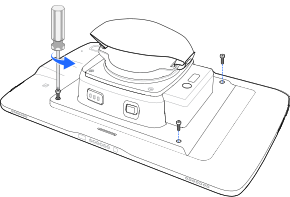
Using a T5 Torx screwdriver, remove four screws securing expansion back to the device.
Lift Expansion Back off the device.
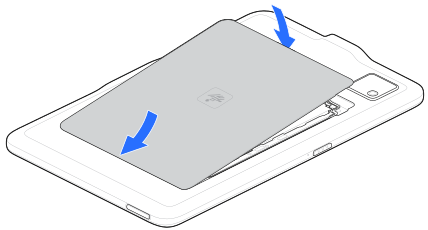
Insert the tabbed end of the battery cover into the slots in the battery well.
Rotate the cover down.
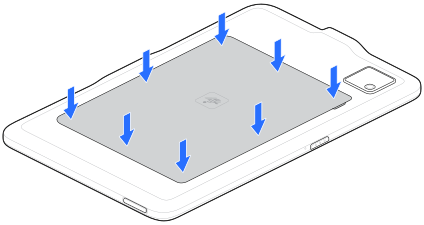
Carefully press down around the edges of the cover. Make sure that the cover is seated properly.
Press
Power
to turn on the device.
Expansion Back
×